

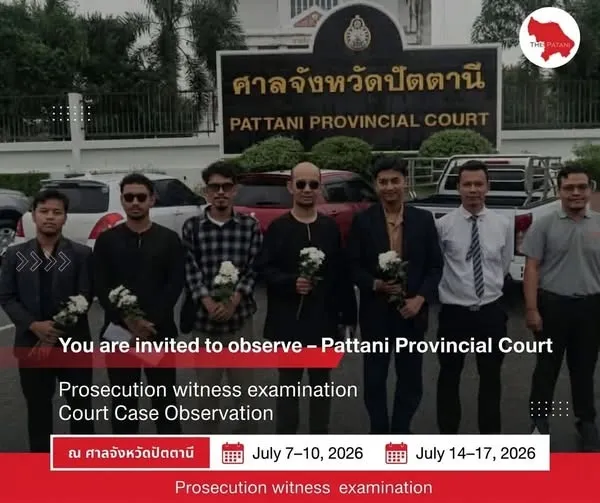
Patani, 7 July 2026 – The Patani Court held further proceedings in the case of five Patani student and CSO activists from July 7–10, 2026, and continued from July 14–18, 2026. This phase of the trial involves the presentation of witnesses by the prosecution. According to a source at the Patani Provincial Court, a preliminary hearing had previously been held on January 13 to address the defendants’ rights, review the evidence, and set the trial schedule.
The five activists are: first, Irfan Umar—who at the time served as Chair of Pelajar Bangsa and was a student at Princess of Naradhiwas University (PNU) in Narathiwat; second, Sareef Salaeman—who at the time was a student at Prince of Songkla University (PSU), Pattani Campus; third, Hussen Buenae—then Chair of the Student Organization at Yala Rajabhat University (YRU); fourth, Artef Sohko—Chair of The Patani; and fifth, Hakim Pontigor—then Chair of Patani Baru and Deputy Secretary-General of the Fair Party.
On October 3, 2024, investigators recommended prosecution and referred the case to the prosecutor’s office. The five defendants reported to the prosecutor’s office for the first time on the same day.
Separately, the defendants and their attorneys from Thai Lawyers for Human Rights (TLHR) filed a petition with the House of Representatives Committee on Law, Justice, and Human Rights, expressing concern that the prosecution might constitute a Strategic Lawsuit Against Public Participation (SLAPP).
Subsequently, on November 20, 2025, the Public Prosecutor filed charges at the Pattani Provincial Court. The five defendants were formally charged under Section 116: “rebellion” (maximum penalty: 7 years in prison), Section 210: “criminal organization” (maximum penalty: 5 years in prison) as defined in the Thai Criminal Code, and Irfan Umar faced additional charges under the Computer Crimes Act.
Chronology of the Case Involving 5 Activists
This case began with an academic event organized by the Patani Student Movement (Pelajar Bangsa), which included lectures, panel discussions, and a referendum simulation—creating a space for open dialogue on the principle of self-determination and the path to peace in the Patani region.
On June 7, 2023, the activists officially launched Pelajar Bangsa, which held its inaugural event in the Sriwangsa Meeting Hall at the Faculty of Political Science, Prince Songkla University, Pattani Campus. The event began with a keynote speech titled “Self-Determination and Peace in Patani” by Assoc. Prof. Dr. Mark Tamthai, a peacebuilding expert from Payap University. This was followed by a referendum simulation and an academic panel discussion, which served as a platform for developing political ideas to resolve the long-standing conflict in Patani.
Naturally, the event attracted widespread attention from students, academics, civil society, and the general public, and quickly sparked a broader debate regarding the limits of academic freedom and public discourse in Thailand.
However, the legal proceedings against the five student activists began with a complaint filed by Lieutenant General Santi Sakuntanak on June 23, 2023—who at the time served as Commander of the Fourth Military Region—who sent a representative to file an official complaint with investigators at the Mueang Pattani Police Headquarters, demanding that those involved—including members of Pelajar Bangsa, politicians, political parties, and civil society representatives—be charged with criminal offenses.
The State and International Community Must Monitor the Trial of the Five Students
To that end, The Patani hopes that the state and the international community will monitor the trial, which is expected to proceed in an unfair manner. Patani students and CSOs held an academic discussion to present strategic ideas for addressing the unresolved armed conflict.
“A referendum” is the path to democracy; all parties must respect the social and political rights of the people of Patani. When the Anglo-Siamese Treaty was signed by the Kingdom of Siam and the British Empire on March 10, 1909, the people of Patani were never asked for their consent. “Therefore, in our view, a referendum is the path to democracy—it calls on all residents of Patani to determine their own future. The British government should also bear responsibility because it never sought our opinion during the Anglo-Siamese Treaty,” he concluded.